 EN
EN
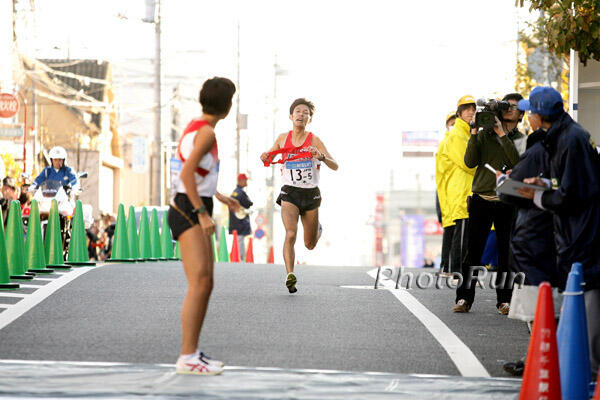
2009 Chiba Ekiden Relay Chiba, Japan November 23, 2009 Photo: Kazu Eguchi@Photo Run Victah1111@aol.com 631-741-1865 www.photorun.NET
Some Reflections on the Ekiden – by Brett Larner – Japan Running News
This ekiden season I've had a few thoughts kicking around, and watching this week's Hakone Ekiden a few of them became clearer. These are still in progress, but at the moment this is what I'm thinking in terms of running as a spectator sport and about the quality of Japanese men's distance running right now.
Quality: Japanese men's running is coming up very, very quickly. I was in the lead car at November's Ageo City Half Marathon, where 18 men, 17 of them university runners, broke 63 minutes. As it was going on we all thought it was a slow race because there were so many people running that pace all the way, no separation at all in the mass of the pack. See the JRN header photo above, taken just past halfway. That's pretty unusual in Japan, especially at the university level; generally you'll get a handful of guys run an aggressive pace and a mass running dead on a safe pace, 3:00/km in a half marathon, for example.
The First Stage of Hakone this year was exactly the same: Waseda University star Suguru Osako, fresh back from training with Alberto Salazar's Nike Oregon Project before Hakone, took the 21.4 km stage out at sub-60 minute half marathon pace, and the entire field of 23 went with him. The announcers immediately said, "This is an extremely fast pace. The pack will break up very soon." When it didn't they said, "Well, it's actually a slow race. Everybody is still there." Not until 5 km, which the group hit almost completely intact in 14:09, 59:42 half marathon pace, did they realize what was happening.
Sure, a lot of the guys who went out at that pace died, some badly, but compare the results to when Osako won the First Stage in 2011 and 2012. In 2011 he ran 1:02:22 and won by nearly a minute, nobody daring to run that kind of pace. In 2012 he ran 1:02:03, the fifth-fastest time ever on the First Stage, only one guy trying to go with him and ending up almost 30 seconds back. This time Osako ran 1:02:14, a time that would have been all-time #7 before this year, and ended up 5th. 4th-place Kei Fumimoto of Meiji University ran 1:02:02, one second faster than Osako's 2012 winning time. The top six were all faster than his 2011 time. Winner Hideto Yamanaka of Nittai University ran 1:01:25, 1:00:33 half marathon pace, not quite sub-hour but just off national record pace.
The character of the running here and in Ageo was completely different, 180 degrees from the mindset seen even last year, and it was there on other stages too, more like the type of marathons we've seen in Dubai and elsewhere the last few years: throw lots of young, unknown guys together and have them run some completely unrealistic pace. Most of them are going to die, but a few will break through with something more. Either way, just look at some of the numbers: in 2011 there 15 men in the Hakone field with times under the "ace" level of 13:40/28:30/59:30/1:03:00. In 2012 there were 19. Last year there were 32. This year there were 41, with 18 of the 23 teams at Hakone having at least one athlete at that level.
Every single one of those 23 teams, three more second-tier schools making it in than usual in honor of Hakone's 90th running, had runners with 10000 m bests under 29 minutes. American writer Jesse Squire tweeted me that in all American universities in 2013 combined there were 13 men who broke 29 minutes. Winner Toyo had two 27 minute men, twins Keita and Yuta Shitara, and six more who had run 28. 6th-place Meiji University had 11 men with 5000 m bests under 14 minutes, the fastest, Genki Yagisawa, having run 13:28.79 this fall. In the entire Hakone field there were 64 men sub-14 for 5000 m, two of them sub-13:30, 81 men sub-29 minutes including 4 who have run 27 minutes, and 34 sub-63 half marathoners, 6 including the Shitara twins who had run 61. Just five years ago these kinds of numbers would have been unthinkable, and they don't include the runners at other schools that didn't qualify for Hakone, of which the number also increased this year.
This generation of Japanese collegiate men is the one that will hit its peak at the 2020 Tokyo Olympics. I have the feeling that this new attitude, this new willingness to take risks and throw it all away in search of something higher instead of taking the safe, conservative approach, is going to last at least until then. With the front end of this generation just now hitting age 22 who knows how far they will go once they begin to seriously run marathons? I'll have an article up later this week looking in detail at the complete rosters of all 23 schools at this year's Hakone Ekiden and a few comparisons from the top end of the 2013 NCAA DI XC Championships.
Context: People in the industry in other countries frequently talk about how to make elite running more popular with the general public. Why is it that it's so popular as a spectator sport here, with tens of millions of people tuning in to watch a fifteen-hour broadcast of a small number of university guys running over the course of two days? The easy answer is just to brush it off on culutre; the Japanese value tradition, self-sacrifice for the greater good, perseverance in the face of hardship, and whatever other cliches about the exotic Orient you want to dish out.
But watching Hakone this time I could really feel that a big part of what makes the ekiden great entertainment is that is provides a larger context for the action of running, something multi-dimensional and whole. Watch a regular race and most of the time you will only see a few people going head-to-head or somebody time trialing. It's exciting for serious fans and the average person might watch it once or twice, but there's no overall story there, no larger drama or plot. It seems to me that the situation in track and field and road running now is much the same as if baseball were just a series of home run derbies or soccer an endless series of penalty kicks. The hardcore fans might like it and the average person might be entertained by it once or twice, but build an entire sport on it? Baseball and soccer both have a lot more going on, requiring a range of skills from different people to build something complex and compelling.
That's what you have in an ekiden relative to an ordinary track, road or cross-country race. Just like home runs and penalty kicks factor into their sports, pure speed and head-to-head competition factor into an ekiden, but only as elements of something bigger, killer plays in the overall game. There is strategy, not just tactics, room for somebody like Ichiro and other skills that runners who are not the fastest can bring into play to contribute to the evolution of the overall game. Just as baseball and soccer appeal to mass audiences as multi-dimensional team sports, so does the ekiden in Japan.
In terms of it being a team sport, I was struck this fall by something that Robert Johnson of Letsrun.com wrote about reasons why running would never be popular as a team sport. One of the things he wrote was that team scoring in cross-country means that it's often a long time after the race before anybody knows what team won because it is based on an arbitrary scoring system of individual performances in a crowd. I think he's right on the money there.
If you look at the one place where running is popular as a team sport, it's crystal-clear who won, because it is a genuine team performance. Individuals race head-to-head, win their stages and are recognized for that, but it's actually about the team performance, and the fans like that. Like Yamanashi Gakuin University at Hakone this year, if one person goes down, the whole team goes down.
The emphasis on the team also means that, like other team sports, there is less impact when an individual doesn't race. How many times have you been looking forward to a marathon, road race or track race where one of your favorite runners, Galen Rupp or whoever, is scheduled to run, only for them to pull out at the last minute? When the big names dodge each other? Or when people's careers come and go prematurely? Like in other sports, if the emphasis is on a team it's less of an issue for fans if one guy doesn't play.
Look at Hosei University at Hakone this year, for example. Their star runner Kazuto Nishiike, one of the best Japanese collegiate runners this year, had a mishap and got hurt on Dec. 29 and couldn't run Hakone. If it were a regular race it would be a big blow for the organizers, fans would be disappointed, and the race would be lessened. Instead, Hosei spent most of the race battling to stay in the top ten to get a place at October's Izumo Ekiden and a guaranteed place at Hakone next year. Its battle, which it ultimately lost, with Daito Bunka University for 10th place on the last stage was one of Hakone's highlights this year; sure it would have been different with Nishiike and he probably would've run great on whatever stage he ran, but Hosei's fans still got a great race, maybe a greater one. Everybody's going to remember Hosei vs. DBU for 10th, not Nishiike.
And that's something the TV producers understand. When you have a complex, multi-dimensional event going on, cover more than one dimension. People respond when there is different action going on and they get to see it. When someone has a lead of over a kilometer it's good to check in sometimes and see them balling, but what about all the other competition going on inside the race? You keep people hooked, keep them watching when you're switching between different races-inside-a-race. OK, this is a great race between this group of guys.
What's up with the guy up front? Still solid. Whoa, check out this dude coming up fast in the distance. Hold the phone, that one guy in the group is in trouble! It's actually entertaining to watch, gripping, and the Hakone broadcast producers at NTV do a better job of presenting it that way than anybody else in the sport, anywhere.
The same aesthetic spills over into Japanese marathon broadcasts. In comparison I can't help but think back to last year's NYC Marathon broadcast on ESPN. NYC does a great job these days of putting together interesting, varied fields with a range of different athletes. ESPN's broadcast was good from a technical standpoint but completely monotone. Only the famous names up front, period. How about showing what the top Americans are doing? How about showing that guy in the red singlet by himself in the distance who's coming up and running people down, or at least saying who he is? What's the point in having an intriguing, multi-dimensional event if you're only to present one dimension?
Anyway, it's not as though the ekiden is a quick-fix, that if USATF or the IAAF suddenly switched to an all-ekiden format there would suddenly be tens of millions of fans lining up or tuning in; Japan has decades of fan base buildup that is pushing things forward. I remember the World Marathon Majors saying that the series' creation was partly out of recognition of the need to provide some sort of larger framework to appeal to fans.
That's one approach, regardless of whether or not it has been successful. But on some level in Japan they've identified some of the same problems that people like Johnson have brought up and developed other effective solutions. Some of those solutions might be worth looking at more closely.
(c) 2014 Brett Larner
all rights reserved
by Brett Larner – Japan Running News
