 EN
EN
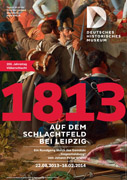
VISITING GERMANY: CULTURE - BERLIN - 1813 – At the Battlefield near Leipzig - A tour through the painting “Declaration of Allied Victory” by Johann Peter Krafft ©DHM - Deutsches Historische Museum - German Historical Museum - BERLIN
VISITING GERMANY: CULTURE – BERLIN – 1813 – At the Battlefield near Leipzig – A tour through the painting “Declaration of Allied Victory” by Johann Peter Krafft
The historical context round about the Napoleonic Wars and Wars of Independence will be explored, no less so than the culture of remembrance, which draws on both patriotic and nationalistic feelings. With a view to the consequences the exhibition examines the immediate and long-term ramifications for Germany and Europe, which can be summarized in the events surrounding the Congress of Vienna, the redrawing of the territorial map, the disappointed hopes for national unity and the Age of Restoration.
Individual scenes from the painting will be enlarged photomechanically and displayed next to each other in the exhibition room so that viewers can pass by them as if in a “walkable” paper theatre.


History of the Zeughaus
![[Old View of the Zeughaus]](https://www.dhm.de/gifs/zeughist.jpg)
View 1828; from left to right: New Guard, Zeughaus, Castle bridge, castle of the Prussian kings
![[New View of the Zeughaus]](https://www.dhm.de/gifs/zeugneu.jpg)
View winter 1996/97; from left to right: New Guard, Zeughaus, TV tower, Castle bridge, Palace of the Republic (former East German parliament)
On 28 May 1695, the Elector Friedrich III of Brandenburg (who after 1701 called himself King Friedrich I in Prussia), gave the orders to lay the foundation stone of the Berlin "Zeughaus", the Arsenal. The first architect was Johann Arnold Nering. He was followed by Martin Grünberg and then, from 1698 to 1699, by Andreas Schlüter. The building was given its final exterior form by Jean de Botd in 1706. But it wasn't until 1730 that the construction was finally completed.
The Zeughaus is the oldest building located on the avenue Unter den Linden. It is one of most beautiful secular buildings of the Baroque period in northern Germany and owes its special place in art history to the high quality of its sculptural works.
From 1731 to 1876 the Zeughaus was used as an arsenal by the Prussian military. The building served to store weapons, spoils and trophies of war. By the 18th century the Zeughaus was the largest weapons' depot in Brandenburg-Prussia.
After 1815 Karl Friedrich Schinkel was commissioned to carry out extensive restorations on the building; Johann Gottfried Schadow was put in charge of restoring the sculptural ornamentation.
The "Royal Weapons and Model Collection", put together in 1828, was first opened to the public in 1831.
By request of Emperor Wilhelm I the Zeughaus was reconstructed from 1877 to 1880 by Friedrich Hitzig to form the "Pantheon of the Brandenburg-Prussian Army". The extensive artistic decoration of the Pantheon wasn't completed until 1891. In this way the old Prussian weapons depot became a museum of Prussian history with a notable collection of militaria. After World War I the Zeughaus, which until then had been under the supervision of the Ministry of War, was incorporated into the "Prussian Art Collections" as the "Staatliche Zeughaus" or "State Arsenal".
In 1939 Adolf Hitler gave orders to have the army museums in Berlin, Munich and Dresden taken over by the Wehrmacht. From this time on the spirit of German heroism, such as the National Socialists understood it, was propagated in the Zeughaus. Parades and commemorations in the open courtyard were part of the German war propaganda until 1944.
In 1944/45 the building was severly damaged by bombs and grenades.
In 1945 the Allied Military Command of the city closed down the "War Museum Zeughaus". The reconstruction of the building went on from 1948 to 1965.
From 1952 to 1990 the "Museum for German History", founded by the Central Committee of the SED (Socialist Unity Party), was located in the Zeughaus. The aim of the museum was to convey the Marxist-Leninist concept of history. As the central museum of history in the German Democratic Republic it undertook extensive activities to collect and display historical material.
In September 1990 the museum was dissolved by the last government of the GDR. Its collections and properties, including the Zeughaus, were transferred into the hands of the German Historical Museum, founded three years earlier by the Federal Republic of Germany and the Land Berlin.
Source: German Historical Museum – BERLIN
German Historical Museum – BERLIN
Deutsches Historisches Museum
Unter den Linden 2
10117 Berlin
Phone: +49 – (0)30 – 20304 – 0
Fax: . +49 – (0)30 – 20304 – 543
Current Exhibitions
I.M. Pei Building
Hinter dem Gießhaus 3
10117 Berlin
Opening hours:
Daily 10 a.m. – 6 p.m.
The DHM will be closed
24 December
Booking of Tours for Groups and School Classes, Registration and Information :
Permanent Exhibiton: +49 – (0)30 – 20304 – 751
Current Exhibitions: +49 – (0)30 – 20304 – 750
