 EN
EN
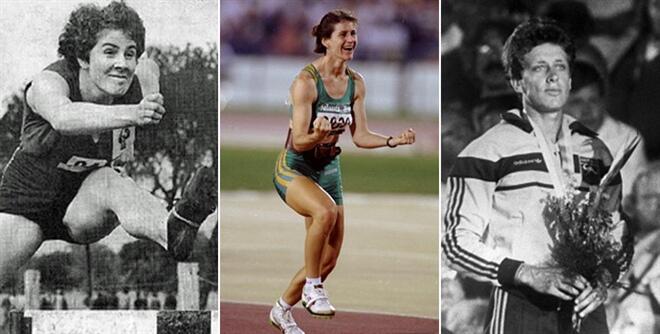
Athletics Australia - News - HALL OF FAME ©Athletics Australia
Athletics Australia – News – HALL OF FAME
Australian athletics has a rich history of success dating back over 100 years.
In celebration of the Sydney 2000 Olympic Games, the Athletics Australia Hall of Fame was established to recognise the outstanding achievements of Australia's truly great athletes and since then a total of 37 people have been added to the illustrious list.
Formally inducted as part of the John Landy Lunch today were Gary Honey, Louise Currey and Norma Thrower, with the trio joining the likes of Catherine Freeman, Betty Cuthbert and Ron Clarke.
The Special Awards Committee has prepared citations to celebrate the inductions, with these detailed below.
On behalf of Athletics Australia, we congratulate today’s inductees, as well as Franz Stampfl who was added at the end of 2013, on their induction to the Athletics Australia Hall of Fame.
GARY HONEY (26 Jul 1959 – )
After seeing future Olympian Ian Campbell dominating school meets, Gary Honey’s father Ron approached Ian’s coach Dr. John Boas and asked where they trained. Ron duly delivered the young Gary to the next session. John remembers a skinny young teenager who wanted to be a triple jumper and wondered what he could do with him. However after watching Gary jump a few times he was confident there was something there.
Gary was originally with the Keon Park Athletic Club in Melbourne but transferred to Ivanhoe Harriers, which was an A Grade club. He quickly settled into the training group and in 1977 he became the national junior triple jump champion with a jump of 14.54 metres. At the same time Gary was also long jumping and a year later finished second in the national junior long jump with 7.49m whilst defending his triple jump at 15.24m.
John suggested to Gary that he concentrate on the long jump and rapid improvement followed. In 1979 he won the senior national title with 7.86m. He was selected for the Oceania team for the IAAF World Cup in Montreal, Canada at which he finished fifth with 7.72m behind winner Larry Myricks (USA).
Gary missed the 1980 Nationals but was still selected, based on his season’s performances, in that year’s Olympic Team. In Moscow he had run up problems in the qualifying round and only managed to get one jump of 7.44m to count, which was not far enough to make the final.
Gary bounced back after the disappointment of Moscow and won the 1981 Nationals with 8.01m, which earned him another World Cup selection – this time in Rome, Italy. There Gary came up against one of the greatest ever long jumpers in Carl Lewis. Lewis did not have it all his own way but found 8.15m enough to hold off Gary’s 8.11m which delivered the Australian his first international medal – a silver.
In 1982 Gary won the national title again with 7.99m and would go on to win the next seven to make it a total of ten national titles overall.
That year also brought the Brisbane Commonwealth Games. Gary was in great form and had the event won on his first jump of 7.84m. Nonetheless he went onto jump 8.13m to easily defeat Steve Hanna from the Bahamas. Commonwealth champion was a title that sat well with Gary but he wanted more.
In 1983 the IAAF introduced the World Athletics Championships, which were inaugurated in Helsinki, Finland. Gary jumped 8.12m in the qualifying round to make the final where he again confronted a now close to invincible Lewis. The US star jumped 8.55m on his first jump to win comfortably. Gary leapt 8.06m to finish a fine sixth.
Gary demonstrated his versatility as an athlete in Helsinki – also running the opening leg of the 4x400m relay heats. However Australia did not progress.
Gary was indeed a quick sprinter with a hand timed best of 10.4 in 1985 but what surprised many people was that he could run a very good 400 metres. Although he did not like the event, he achieved a personal best of 46.9.
Gary won the 1984 Nationals long jump with an impressive 8.15m and was in outstanding shape heading towards the 1984 Los Angeles Olympics. At the Games, he qualified for the final with 7.93m. In the following day’s final Lewis was omnipresent and opened with a cool 8.54m which would eventually be the winning jump.
Gary began with a safe 7.97m and was in fourth. In round 3 he improved to 8.18m to move into second. But in the final round the Italian Giovanni Evangelisti registered 8.24m to nudge ahead. Gary thus had to produce something on his last jump and did – but it was also 8.24m the same as Evangelisti’s best. The officials correctly assessed that Gary had the next best jump at 8.18m – securing him the silver medal on count back.
After the Games, Gary toured Europe and in Budapest, Hungary he set a life time legal best and national record of 8.27m to beat some of the best East European jumpers who had been forced to boycott the LA Games. By the end of 1984 Gary was clearly the world’s number two behind Lewis.
Gary’s next international representation was at home again with the IAAF World Cup in Canberra. 7.98m saw him finish fourth behind winner Mike Conley (USA) at 8.20m.
Gary competed in the 1986 Commonwealth Games in Edinburgh, which was seriously affected by a boycott of many countries. Gary retained his long jump title with a second round jump of 8.08m and then he competed in the triple jump, which he had not done for 10 years to help team mate Peter Beames. He managed a personal best of 16.16m to finish just outside the medals. He also ran a leg in the 4×100 metres relay but the Aussies were unfortunately disqualified.
Gary continued his dominance of the domestic scene and won the 1987 and 1988 Nationals with huge windy marks of 8.22m and 8.30m. He had high hopes for success at the Seoul Olympics in 1988 but sadly tore a quad muscle in training just before the Games and was forced to withdraw.
He won the 1989 Nationals with another big jump of 8.11m, but injuries began to take their toll. Gary was selected for his third Commonwealth Games in Auckland, New Zealand. He made it through the qualifying round with 7.69m but could only manage 7.54m in the final to finish tenth.
Those Games effectively brought down the curtain on Gary’s outstanding career highlighted by Olympic silver, two Commonwealth golds, ten senior national and 12 state titles and a long stint as national record holder.
Gary also dabbled in “pro” running – controversially winning the 90m maiden handicap at the famous New Year’s Day meeting at Burnie in Tasmania. He tried a brief comeback in 1994 but alas it lasted just one competition.
LOUISE (McPAUL) CURREY (24 Jan 1969 – )
Louise McPaul began her athletic career in Little Athletics in Wollongong. As she developed she initially emerged as a talented heptathlete, progressing so well that by 1986, she was selected to compete in the inaugural IAAF World Junior Championships in Athens, Greece. At just 17, she finished a creditable 13th in the seven-event competition with 5,013 points.
From an early age she had been coached by Tony Roberts and competed for her beloved Illawara Blue Stars Athletic Club. Still young enough, Louise competed in her second World Junior Championships two years later in Sudbury, Canada but this time in the javelin as she had injured her knee making the long jump problematic. Indicating little of what was to later emerge, she failed to advance to the final with a throw of 47.94 metres in qualification.
But things began to click and Louise won her first senior Nationals in 1990 with a throw of 57.06m and then retained her title in 1991 with 60.20m. She was progressing rapidly and not surprisingly was selected for the 1991 World Championships in Tokyo. There she demonstrated the capacity to produce in big competitions that would become her trademark – throwing 63.34m to finish sixth behind China’s Xu Demei 68.78m. Prior to Tokyo there had been a fourth place with 57.60m at the World University Games in Sheffield, England.
In 1992 Peter Lawler, who had also been a national javelin champion (in 1971), took over Louise’s coaching and her next major international was her first Olympic Games in Barcelona. She threw 60.56m in the qualifying to make another final where she finished 11th with 56.00m.
Louise did not have it all her own way in Australia – developing a serious but friendly rivalry with Queenslander Joanna Stone who beat her in the 1994 nationals with 62.40m to 61.44m. The culture in women’s javelin in Australia was strong at the time and as a result at the 1994 Commonwealth Games in Victoria, Canada there were three female javelin throwers. Louise showed that she was at home on the biggest stages – dominating the competition from the outset to win with her opening throw of 63.76m. Joanna finished fourth with 57.60m and Kate Farrow sixth with 56.98m.
Louise then travelled to London to represent Oceania at the IAAF World Cup where she threw 59.92m to finish fourth. The following year at the 1995 World Championships in Göteborg, Sweden she narrowly missed the final after a throw of 59.30m, finishing 13th overall.
Her second Olympic team came in 1996 and these Games were destined to deliver Louise her greatest international result. In Atlanta she qualified with 62.32m to make the following day’s final. Heli Rantanen (Finland) opened with a personal best 67.94m which would hold up for the gold medal. However behind the Finn a great battle developed for the minor medals.
Louise moved into second with her opening throw of 61.72m and by the end of round three after launching a throw of 64.18m, she had consolidated this position. But there was no time for complacency as in round five the Cuban pair of Isel Lopez and Xiomara Rivero moved ahead with throws of 64.68m and 64.48m. Then in the final of the six rounds, Norwegian legend Trine Hattestad also swooped past with 64.98m to move into second.
This left the Australian suddenly back in fifth place with Germany’s Karen Forkel with one throw to come after her. Louise rose to the challenge with a magnificent throw of 65.54m to win the silver medal. Just before she threw, television broadcasts showed shots of the Wollongong girl seemingly mesmerised by the Olympic flame burning in the Stadium’s cauldron. Again the athlete had responded when it most mattered.
The next Commonwealth Games for Louise was in 1998 in Kuala Lumpur where she was again in outstanding form and threw a magnificent personal best of 66.96m to win gold and retain her Commonwealth title. Any of her six throws would have won the event.
In January 1999 the IAAF modified the women’s javelin moving the centre of gravity forward – although the 600gm weight remained the same. Louise adapted well to the change and quickly went beyond 60 metres. She was selected for the next World Championships in Seville, Spain. In the southern Spanish city she competed for the first time under a new name, having married fellow javelin thrower and Olympian Andrew Currey in 1998. She threw 64.38m and finished fifth. The downside in Seville was that her javelins were stolen – the Cubans being the prime suspects.
Louise next prepared herself for a third and home Olympics in Sydney and in August threw a new Australian record of 66.80m on the Gold Coast. However disaster struck soon after when she tore her anterior cruciate and medial ligaments in her knee during the Trials. She was still selected for the Games but had now moved from being one of the favourites to potentially not able to compete at all. Louise still believed she could do it and with a heavily strapped knee she still tried to throw and bravely managed 53.32m before fouling her second attempt and passing her third. Not the way she wanted to finish but still fighting all the way.
Louise believed she learned much from her Olympic experiences and was proud and happy about her ability to challenge herself and stand up to adversity.
Hers was an unquestionably magnificent career that saw her win Olympic silver and two Commonwealth golds, be a finalist in two World Championships and a World University Games, collect five national titles and at time of writing remain the national record holder and be ranked 15th on the World All-Time list.
NORMA (AUSTIN) THROWER (5 Feb 1936 – )
Norma began her life in athletics as a sprinter in 1950 – but her father Arnold ‘Joe’ Austin introduced her to the hurdles where she became a world-class competitor and an Olympic medallist. Joe, who ran in the Bay Sheffield in the late 1920s, remained her coach throughout her career.
Not long after starting athletics Norma competed in the 1950 National Women’s Championships at home in Adelaide. She was only 13 and was disqualified for breaking in her heat of the 80 metres hurdles.
She competed for the Western Districts athletics club in Adelaide and in 1951 won her first state hurdles title – over 80 metres. She went on to win 18 South Australian championships over 100 yards, 220 yards and in her favoured 80 metres hurdles.
Norma had to wait until 1952 for her next Nationals as the women’s championships were only held every two years. In Melbourne whilst still only 15 Norma finished second behind Shirley Strickland in the 80 metres hurdles. She also finished sixth in the 100 yards final won by Marjorie Jackson and was a member of the South Australian relay team which took silver.
The British Empire and Commonwealth Games in 1954 were to be held in Vancouver and Norma had a good chance of making the Australian team despite competition for hurdles places being fierce. The Nationals were on Leederville Oval in Perth with Olympic champion and hometown girl Shirley Strickland the favourite. Norma came third in a blanket finish behind Gwen Wallace and Marlene Middlemiss in 11.5. Shirley did not finish.
In the end both Gwen and Marlene were selected for Vancouver whilst Shirley and Norma missed out. In those days it was possible for four athletes to be selected for an event in the Commonwealth Games but the selectors opted only for two.
The next Nationals were in 1956 in Brisbane and would be a good indicator as to who would make the team for the Melbourne Olympic Games. Norma won the hurdles in 11.2 secs.
Selection trials were separately held in Melbourne in October and Norma was selected for her first Olympic Games. At the Games, she won her first round heat in 10.8 (10.94) and later in the day finished second in her semi-final in 11.0 (11.20) into a headwind.
The final on the following day was again run into a headwind and Strickland defended her Olympic title in 10.7 (10.96) with Norma taking the bronze medal in 11.0 (11.25) in a photo finish from Galina Bystrova of the USSR, who recorded the same time.
With limited international opportunities for Australia’s athletes in those days, Norma’s next target was the 1958 British Empire and Commonwealth Games in Cardiff. The women’s Nationals were held on the Sydney Sports Ground, also serving as the selection trials. Norma ran a sensational final equalling the world record of 10.6. Unfortunately a following wind of +2.9 negated the record. However the win ensured her selection along with 1956 Olympic team mate Gloria Cooke and Wendy Hayes.
In Cardiff Norma won her heat in 10.8 (10.79) and then took the gold in the final with 10.7 (10.72) with Gloria third in 10.9 (10.94) and Wendy fifth in 11.2 (11.21). Both races had big tail winds so no records could be claimed.
After the Games Norma toured Europe with a group of her teammates including Betty Cuthbert, Herb Elliott, Albie Thomas and New Zealander Murray Halberg packed into a Gordon Pirie Kombi van replete with sleeping bags and spikes. They ran in Belgium and also in Scandinavia and watched the 1958 European Championships in Stockholm before returning via Nigeria.
The 1960 National Championships were held on the quaint North Hobart oval in March and Norma won by inches over Cooke, with both getting the same time of 10.9. They just pipped future Olympian Pam Kilborn, with the great Strickland back in fifth place. Nearly three weeks later at the Brisbane Exhibition grounds Norma equalled the world record of 10.6 – and this time the wind was legal.
Norma went to the Rome Olympics as one of the favourites but her form had deserted her. She finished second in her heat in 11.4 (11.54) but was only fifth in her semi in 11.3 (11.46) and missed the final. She also ran in the 4×100 metres relay but unfortunately the team was disqualified after dropping the baton.
After the Games Norma finished her wonderful athletic career crowned by an Olympic bronze, Commonwealth gold and a world record but also including one national and eight South Australian records, three national championships and 18 South Australian titles.
Paul Jenes OAM
Athletics Australia Statistician
President ATFS
Athletics Australia – News
