 EN
EN
OLYMPUS DIGITAL CAMERA
89th Annual Comrades Marathon, June 1st, 2014 – The Pride of South Africa – By Horst Milde
South Africa’s Comrades Marathon is world famous. The term ‘Marathon’ is actually misleading, because it is actually an ultra-marathon covering a distance of about 90 kilometres, over a difficult route. We have often reported about the race on this site over the last few years.
The race has been in existence since 1921. It was started by Vic Clapham, a British soldier who wished to create a memorial race for his fallen comrades and the hardships, which they suffered. In the first Comrades race in 1921, 34 runners started, but only 17 completed it.
The course is about 90 km long, and every year the starting and finishing points swap places. One year it goes downhill from Pietermaritzburg to Durban, the following year it then goes uphill from Durban to Pietermaritzburg.
Now with its 18,000 participants (limited), this event is the pride and the figurehead of the sport in South Africa, complete with a live national television broadcast of the entire 12-hour race. Competitors must reach the finish line within this time limit. Brutally, the finish line is closed exactly 12 hours—down to the second—after the start. There is no last chance for runners to hurl themselves over the finish line—even if they are just one second too late, they are thrown back!
The Comrades Marathon, being Africa's largest ultra-running event, has been a member of AIMS for quite some time. The organizers of the race, led by Gary Boshop, who is a member of the AIMS Board, applied to host the 20th AIMS Congress in 2014, and during the 2012 Congress in Prague they won the contract to do so.
From May 29-31, 2014, the 20th AIMS Congress was held in Durban (we have already reported on this on the GRR website). This not only paid tribute to Africa, but was also an overdue gesture and a thank you to the continent, whose outstanding athletes and successful runners have graced and decorated the winners’ lists of the world’s major running events, the World Championships and Olympic Games.
This was the first AIMS Congress on African soil. The very first AIMS Congress was held in 1983 in Tokyo, Japan. The third AIMS Congress took place in Berlin in 1985, and the 19th Congress took place in 2012 in Prague. The visit of the AIMS event to Durban was received with due pride by the organizers, the public, and the media. The Comrades Marathon pulled out all the stops, using the experience of their 89-year-old organization to demonstrate the qualities and the venerable and legendary history of this large and tradition-rich run to the Congress’ participants from all over the world.
A mayoral reception was held at the Pietermaritzburg City Hall. The door of the city hall serves as the starting point for the run. There was also a reception at the Durban City Hall, in this city of 3.5 million inhabitants on the Indian Ocean, as well as other social activities around the Congress and the running event.
In the mayor’s and sports associations officials’ speeches, references were made to this year’s 20th anniversary of the abolition of Apartheid in 1994, and appreciation was shown to the late head of state Nelson Mandela for a peaceful transition into a new country. They also referred to the country’s success in the organizing of the 2010 Football World Cup and the pride of being the first country in Africa to now welcome the 20th AIMS Congress as an organizer on African soil.
The highlight of the official coverage of the program was the Comrades Marathon gala dinner (Tribute to COMRADES Marathon Legends) with the idea of showcasing some of the legends of this run—including historical video recordings of the race since 1921. Many of the race’s biggest winners as well as the winners of the last few decades—and there were many—and the top favourites of 2014, were asked to take the stage. At the top of the list was running legend Bruce Fordyce, who won the race nine times from 1981 through 1990 (every year except 1989).
Those runners sporting green start numbers are particularly honoured and admired by the public as extraordinary national sporting legends. Wearing a green starting number means that the runner is either a multiple winner or has run ten times and finished successfully within the required time limit. This method was successfully copied from the Berlin Marathon, where members of the Berlin Marathon Jubilee Club wear green numbers.
In order to experience the start of the race at 5:30 in the morning on Sunday, June 1, 2014, you have to get up at 2:00 clock, then get right into Durban’s heavy traffic jam, because of course the runners are also in their buses headed to the starting line. Things improve once you make it onto the highway to Pietermaritzburg, where things move along more quickly.
As already mentioned, the race begins directly in front of the Pietermaritzburg City Hall. The atmosphere here is really something special when—without any great speeches prior to—the national anthem is sung with fervour, and just before the start of the race, the famous cock-crowing of the legendary Max Trimborn is heard. Within 10 minutes all of the runners are on their way on the arduous path to Durban. It is a “down” run to Durban, next year it goes “up” to Pietermaritzburg
On the return trip back to Durban to the finish line, we could see the sunrise and hoped that it would not be too warm of a day for the participants.
The runners pass through a particular point on the route called “Valley of a Thousand Hills”, where they pass the “Wall of Honour”. Here the successful “green number” runners can purchase a commemorative plaque with their name and race number, which is attached there to a rock.
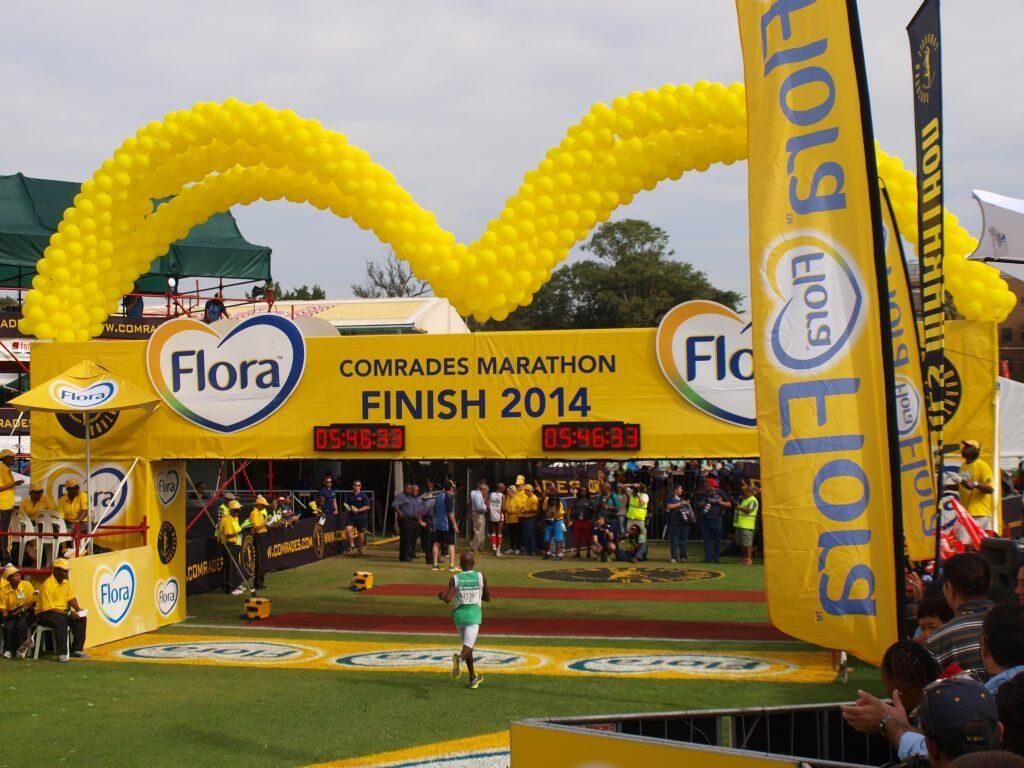
In the cricket stadium in Durban the stands are full, and the audience celebrates with a festival of the heroes of the 89th Comrades. In order to reach the finish line in the middle of the stadium, runners first pass through a fairly long tube inside the stadium, surrounded by the frenetic applause of spectators.
The applause swells more and more when the end of an hour approaches. The “bus”, which picks up the runners who exceed certain times, is driven by a competent operator who sometimes carries a few hundred runners. The tension rises to boiling point when the “12th-hour Bus” approaches. Then it really comes down to tenths of a second. Dramatically it arrives at the finish line, when participants are “thrown” back from the finish line when the limit of 12 hours is exceeded by just one second.
Bongmusa Mthembu from South Africa won the race with a time of 5:28:34. The race was firmly in African hands; of the top ten all were from Africa, except for Jonas Buud from Sweden, who finished seventh with a time of 5:38:17.
A big surprise was the victory of Ellie GREENWOOD from Canada with a time of 6:18:15, beating Russian favourites Elena Nurgalieva (6:23:18.3) and Olesya Nurgalieva (6:24:51). In recent years the two sisters have ruled the race.
Also noteworthy was the 7th place ranking of Zola Budd PIETERSE with a time of 6:55:55, who set a 1984 world record for the 5000m run, but who could not run for South Africa due to Apartheid. She became famous as the barefoot runner for Great Britain at the 1984 Olympic Games in Los Angeles, where she had a collision with US runner Mary Decker at the start of the race causing Decker to fall and place seventh in the race. Today, this mother of three only runs races like the COMRADES, and she does so successfully.
Winner 2014
MEN:
1 Bongmusa MTHEMBU RSA 5:28:34
2 Ludwick MAMABOLO RSA 5:33:14
3 Gift KELEHE RSA 5:34:39
4 Stephen MUZHINGI ZIM 5:35:18
5 Rufus PHOTO RSA 5:35:30
6 Mncedisi MKHIZE RSA 5:36:06
7 Jonas BUUD SWE 5:38:17
8 Manoko William MOKWALAKWALA RSA 5:39:29
9 Prodigal KHUMALO ZIM 5:39:36
10 Latudi MAKOFANE RSA 5:40:41
1 Ellie GREENWOOD CAN 6:18:15
2 Elena NURGALIEVA RUS 6:23:18
3 Olesya NURGALIEVA RUS 6:24:51
4 Irina ANTROPOVA RUS 6:34:08
5 Jo MEEK GBR 6:47:02
6 Caroline WOSTMANN RSA 6:51:43
7 Zola Budd PIETERSE RSA 6:55:55
8 Frida SODERMARK SWE 6:57:33
9 Martinique POTGEITER RSA 7:00:46
10 Julanie BASSON RSA 7:02:50
Worthy of mention from the German perspective is that there was also once a winner from Germany, Charly Doll, who won in 1993 with a time of 5:39:10. Maria Bak racked up three victories in 1995, 2000 and 2002, and Birgit Lennartz won the Comrades in 1999.
For those finishing the Comrades for the tenth time, immediately after they cross the finish line they receive their green number in a special ceremony, which is of course then fittingly celebrated with their whole family right there on the stadium field.
The cricket stadium is a museum in and of itself. In the clubrooms are pictures of cricket teams who had their fame in the early 1900s, as well as long lists of winners, and there is plenty of “antique” cricket equipment on display in glass cases.
During the event, the stadium also becomes a get-together for the successful South African long-distance runners. The Berlin Marathon also has a South African sports history anecdote. The first time South African marathon runners participated in a race abroad after the end of Apartheid was in Berlin: On September 27, 1992, David Tsebe (RSA) won the 19th Berlin Marathon with an excellent time of 2:08:07 – Thabiso Moghali (RSA) came in fifth with a time of 2:13:20.
Xolile Yawa (RSA) repeated the victory by a South African runner on September 26, 1993 at the 20th Berlin Marathon with a time of 2:10:57, and David Tsebe (RSA) finished in third place. It was thus a great pleasure to have Xolile Yawa come to the stadium and revive his friendship with the Berlin Marathon, meeting Mark Milde and the old race director.
It is worth mentioning that the organisers are working hard to increase the awareness and interest in running for the local population through their many activities, such as kids races, charity races and other events.
There is a 10K run for the general public on the day before the Comrades Marathon along the Durban boardwalk, as well as a very popular kids and youth race. The Durban boardwalk is a paradise for runners and cyclists day and night anyway. The official word, however, is that the days of the great South African runners are long gone.
One should also note that there is an excellent museum in Pietermaritzburg, the Comrades Museum, where you can enjoy the many historical items from running legends. The farewell party for the officials and participants in the AIMS Congress took place in the football stadium, and architectural jewel, which was built for the 2010 World Cup. The hospitality of the organisers that we all enjoyed for a few days left an unforgettable impression on everyone.
We would especially like to thank everyone, both up front and behind the scenes, who helped in the celebration of the fabulous running experience of the COMRADES MARATHON. Great praise goes out to everyone, and even a greater thank you. AIMS can be proud of having the COMRADES Marathon as a member of its ranks.
The 90th COMRADES MARATHON will take place on May 31, 2015, and it will undoubtedly be celebrated in a fitting manner for this great anniversary.
Horst Milde
Next Comrades:
90. Comrades Marathon: may 31, 2015
Related:
89. COMRADES MARATHON 2014 – By BRIAN WEBBER
COMRADES MARATHON – AIMS CHILDREN’S RACE A SUCCESS
89. COMRADES MARATHON, SOUTH AFRICA – 1 JUNE 2014 – Bongmusa MTHEMBU and Ellie GREENWOOD
Comrades Marathon: The Ultimate Human Race . By John Cameron-Dow
COMRADES Marathon/South Africa on june 1, 2014 with 18.000 runners
Comrades Marathon – MEDICAL PROTOCOL – ADVICE FROM THE COMRADES DOCTOR
ZOLA BUDD COMPETING IN COMRADES MARATHON – By David Martin
COMRADES MARATHON – Medal History – written by Mike Bath
