 EN
EN
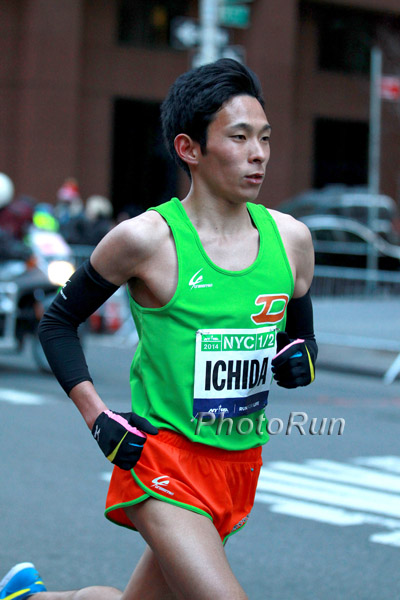
Back in Japan, Sunday features at least three elite-level half marathons across the country. Far in the west, the Kashima Yutoku Half Marathon holds its 64th running, with the centrally-located Yomiuri Inuyama Half Marathon staging its 37th edition with a field including many good university athletes. Two of the three men on the London Olympics marathon team were Inuyama winners while in university, marking the race as a good proving ground for future talent. Further north, the Fukuya City Half Marathon, at just 9 runnings a relative newcomer on the scene, also hosts a good number of collegiates, but its main attraction is local Yuki Kawauchi (Saitama Pref. Gov't). Kawauchi runs just a week after completing his first back-to-back marathon experiment with a 2:15:06 win at the Kochi Ryoma Marathon.
Sunday also features at least two noteworthy mass-participation marathons. The 10000-runner Himeji Castle World Heritage Site Marathon in Hyogo goes off for the first time this year, replacing the Himeji Castle Road Race, an elite 10-miler with more than 50 years of history. And of course there is the Tokyo Marathon.
At the elite men's level it's the best field ever assembled in Japan, with depth equaling last month's Dubai Marathon and far surpassing fellow spring World Marathon Majors London and Boston. Up front are five sub-2:05 men led by aging greats last year's winner Dickson Chumba (Kenya) and Geoffrey Mutai (Kenya) and Tsegaye Kebede (Ethiopia). In the middle, past winner Michael Kipyego (Kenya), London Olympics gold medalist Stephen Kiprotich (Uganda) and 8 Japanese men with current sub-2:10 times. A question mark, the debut of Tariku Bekele (Ethiopia), the younger brother of 5000 m and 10000 m world record holder Kenenisa Bekele. The record for Japanese sub-2:10 times in a single race is 6 at the legendary 2003 Fukuoka International Marathon, but there is a decent chance that will fall Sunday.
Most exciting among the Japanese men is Takehiro Deki (Team Chugoku Denryoku), returning to the marathon for the first time since his 2:10:02 debut without specific marathon training as a junior at Aoyama Gakuin University 3 years ago. This time Deki is lean, showing he has been putting in the training, fast, with wins over two of Japan's greatest 10000 m runners on shorter ekiden stages last month in the midst of marathon training, and confident, saying he is in perfect condition. Look for him to take it to the likes of 2014 Asian Games silver medalist Kohei Matsumura (Team Mitsubishi Juko Nagasaki) and London Olympians Arata Fujiwara (Miki House) and Ryo Matsumoto (Team SGH) as all go for the Beijing World Championships team.
Looking at the history and structure of the Tokyo marathon it's not much of a secret that its women's field is only there to meet the minimum necessary requirements for international accolades like an IAAF gold label and World Marathon Major membership. As a selection race only for men's national teams, stemming from the elite component's legacy as a continuation of the Tokyo International Men's Marathon, Tokyo in its current form discourages elite Japanese women from running, even when they pull in the best international competition to be found on Japanese soil.
