 EN
EN
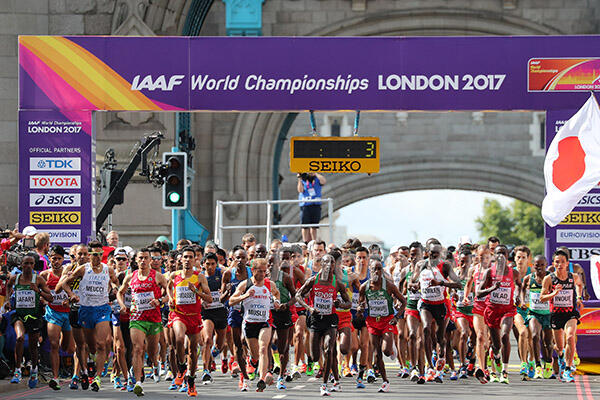

Coming from behind after a mid-race fall, team captain Yuki Kawauchi took the top Japanese men's spot in the London World Championships marathon, running down teammate Kentaro Nakamoto in the final kilometer to finish 9th in 2:12:19.
In the early stages of the race the experienced Nakamoto and Kawauchi held back mid-pack while younger teammate Hiroto Inoue stayed near the front. Early in the second lap Kawauchi missed a drink bottle at one of the aid stations and, momentarily distracted, hit his left thigh on the edge of the next table hard enough to cut it but not enough to slow him down.
When the big move came early in the third lap Nakamoto led the charge in pursuit, the three Japanese men running single file, but Inoue quickly losing touch. Near the top of the short S-curve uphill near 23 km Kawauchi abruptly stumbled and fell, and by the time he got up Nakamoto was over 20 seconds away.

From there Nakamoto settled into the kind of running that has made him the best championships marathoner of his generation, relentlessly pushing ahead and running down one runner after another. From 12th he advanced all the way 9th, with this year's London Marathon winner Daniel Wanjiru (Kenya) coming back into sight in the coveted 8th place.


Wanjiru looked in range in the home straight onto Tower Bridge, but there just wasn't enough time or ground left to catch him. With the fastest closing split after 40 km in the entire field Kawauchi took 9th in 2:12:19 just 3 seconds out of the top eight and from taking the defending London champ down. Nakamoto was 10th in 2:12:41, both of them among the ten fastest times ever by Japanese men at the World Champs. Inoue ended far back in 26th in 2:16:54.
For Kawauchi, in his final Japanese National Team appearance it was his best-ever performance in a world-level championships, and one with the grittiest, most Kawauchiesque finish you could have asked for. At home he'll get criticism for not making top eight, but without the fall there's no telling how much further he might have gone. For Nakamoto it was a race that reaffirmed everything good about him. Three World Championships and an Olympics and never outside the top ten. For Inoue, one of the big hopefuls for the next generation of Japanese marathoners after his 2:08:22 breakthrough in Tokyo this year, it was a disappointment, but one that you can only hope leads to better things.

The Japanese women, almost universally more successful than the men at the World Championships level, turned in the weakest team performance of modern times. Medal contender Yuka Ando and the highly experienced Risa Shigetomo were never in the action. Ando's teammate Mao Kiyota was at the front of the pack in the early going, shifting to its rear after Aly Dixon (Great Britain) broke away from the group. For the middle half of the race Kiyota stayed there, repeatedly dropping out of contact and looking like she was done but coming back each time. Not until the real move came midway through the final lap was she dropped for good, losing almost three and a half minutes on winner Rose Chelimo (Bahrain) over the last 5 km.

Kiyota ended up 16th in 2:30:36. Her teammate Ando rallied a little on the last lap to move up to 17th in 2:31:31, a tough follow-up to her 2:21:36 debut in Nagoya in March. Shigetomo had the weight of a 76th-place finish in 2:40:06 at the 2012 London Olympics on her shoulders, but again unable to run the same way she has in domestic Japanese races she was only slightly better this time, finishing 27th in 2:36:03.

Despite Kawauchi's narrow miss on 8th place, the Japanese women's weak overall performance meant that this was the first World Championships in over 20 year in which not a single Japanese athlete male or female made the top eight in the marathon. With Kawauchi and Nakamoto now in their 30's and high-potential young athletes Ando and Inoue struggling to repeat their early successes it's reason for concern about Japan's situation relative to Tokyo 2020, especially in combination with the absence of any Japanese men in the 5000 m and 10000 m in London. But despite the bleaker larger picture there's at the least the positive of Japan's longtime two best men both wrapping up their World Championships careers doing exactly what they each do best.

