 EN

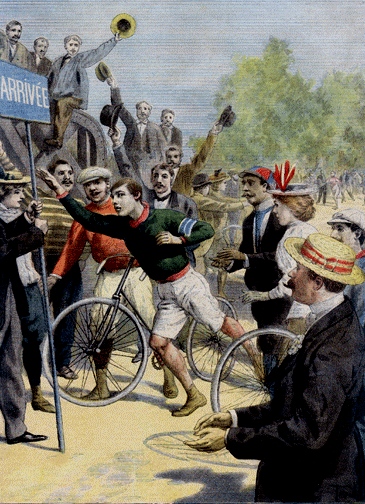
Len Hurst gewinnt 1896 den Paris Marathon - Le petit Journal front page
Paris Marathon: The Oldest City Marathon – and Other Superlatives. The first marathon in Paris took place on July 19, 1896. Prof. Hans Giessen
One of the most prestigious Marathon races is the Paris Marathon.
This coming April, it will take place for the 50th time. But that’s only the second part of the story, because the Paris Marathon actually is much older – the oldest city marathon of all. The first marathon in Paris took place on July 19, 1896.
The date and the event are quite remarkable. The idea of a Marathon arose itself only two years earlier, when philologist Michel Bréal, a professor at the Collège de France, was vacationing in Switzerland. In a letter dated September 15, 1894, he suggested to his close friend Pierre de Coubertin that a race from Marathon to Athens be held as part of the first Olympic Games, which Coubertin was organizing at the time.
Of course, Bréal was tapping into ideas that were already „in the air.“ Individual sports were a new phenomenon, made possible by an increasingly individualistic and affluent society. Long-distance races, even 50-kilometer races, and early races connecting two cities — such as a run from Milan through southern France to Barcelona — already existed. Bréal took up the concept but expanded it with a story, a myth. And he linked the idea to Coubertin’s Olympic project. This would further connect the Olympic Games to Greek history, the race offering „a scent of antiquity,“ he wrote.
Historically, however, there was no marathon as a sport. There was a battle on the plain of Marathon, and a runner who informed the Athenians back home that the battle had been won. Developing the idea for a race from this was left to Michel Bréal. Coubertin enthusiastically embraced the idea.
Thus, the Marathon race is the only sport invented and developed exclusively for the Olympic Games. Everything else, even discus throwing, already existed, independent of Coubertin’s Olympic plans.
The first Olympic Marathon race took place on April 10, 1896. It is noteworthy, therefore, that the first Paris Marathon, and thus the first standalone Marathon, was held only about three months after the Olympic Marathon race.
It was still unclear whether it would develop into something of its own. Apparently, the first independent Marathon race was still linked to the organizers of the Olympic Games, and there is hardly a contemporary account that doesn’t mention Michel Bréal, the Parisian professor who had conceived the idea.
It could have remained a special event, similar to the 1906 Intercalated Games in Athens, held to commemorate the tenth anniversary of the Olympics, which Coubertin had always officially recognized — but which were also only organized because he had his grand idea.
The same could have been true for the Marathon. There was still no institution that could guarantee rules and regularity. The idea had not yet solidified; no one knew how it would develop.
At least there were early indications that the idea of the Marathon race could take on a life of its own. For example, it was considered important to adhere to the „marathon distance“ — not yet precisely defined (the 42.195 kilometers only became official in 1908), but roughly corresponding to the distance from Marathon to Athens, approximately forty kilometers.
And when, in April 1897, just nine months later, the Boston Marathon was launched, the first marathon in North America, it was clear that Bréal’s idea could — and would — take on a life of its own, right up to the present day.
However, although the Boston Marathon is the first city marathon to have existed continuously, the Paris Marathon took place earlier — the very first Marathon conceived as an independent event.
The route of the Marathon race, dubbed the „tour de Paris,“ began at the Porte Maillot. 1,991 runners — all men — started the race. The weather conditions were excelLeonardt. Part of the connection to the historical myth is that hardly any contemporary account failed to mention that the blue sky with its cumulus clouds symbolized the colors of Greece. The route led through Versailles, finishing in the village of Conflans-Sainte-Honorine near Saint-Germain-en-Laye, about 25 kilometers northwest of Paris.
The winner of the first Paris Marathon was the Briton Leonard Hurst, with a time of 2:31:30. His prize money was 200 francs.
Three years later, in 1899, the „Tour de Paris“ Marathon was repeated, this time won by a Frenchman, Albert Charbonnet. In the rematch a year later, Leonard Hurst again emerged victorious with a time of 2:26:28. There were two further revivals in 1902 and 1903, both of which were won by Albert Charbonnet. Then things dwindled, at least in Paris.
It took more than seven decades until the Paris Marathon was revived in 1976 as a completely independent and now regular event. It has since become one of the world’s largest marathons, attracting well over 50,000 participants. And the course is considerably more spectacular today! It starts on the Champs-Élysées and finishes practically in front of the Arc de Triomphe.
The fact that the Marathon is such a successful sport is (also) thanks to the city of Paris and its originator, Michel Bréal. The Paris Marathon thus is a special event, a testament to this triumph, practically at the very place of its birth.
Prof. Hans Giessen
October 3, 2024: Exactly one year ago, the Bréal Marathon took place in Landau. Prof. Hans Giessen
