 EN
EN
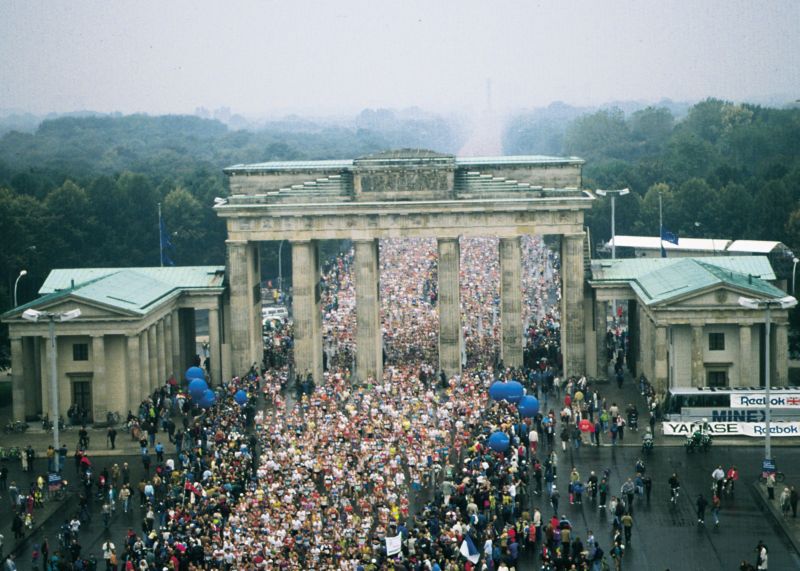
The 1990 BERLIN MARATHON – the Brandenburg Gate without the Quadriga (due to renovation ) – Photo: Berlin Sports Museum
German Reunification Day on October 3, 2024 – A look back: the 17th Berlin Marathon on September 30, 1990 – The “Reunification Marathon” three days before German Unity on October 3, 1990 – Horst Milde reports
The “Reunification Marathon”:
On November 12, 1989, the 26th Berlin Cross-Country Race started at Teufelsberg Mountain in Berlin. This race had a long tradition, but it also had historical significance for the sport, because for the first time after the fall of the Wall on November 9, 1989, runners from East Berlin and the GDR were able to take part in the Berlin Cross-Country Race.
That same day, Roland Winkler (East Berlin), Dr. Detlef Dalk (Frankfurt/Oder) and Gerd Engel (Stendal) were invited to my home for coffee with the cross-country runners from East Berlin and the GDR.
It was decided that there should be a joint ALL-BERLIN NEW YEAR’S RUN on January 1, 1990 from West Berlin (West) to Berlin (East) and back, and then the BERLIN MARATHON “through the Brandenburg Gate” in September 1990.
From today’s perspective – all quite normal! But at that time on November 12, 1989, it was all utopian.
Roland Winkler, Dr. Detlef Dalk and Gerd Engel formed the “GDR Initiative Group BERLIN MARATHON” and on the same day wrote a letter to the Mayor of the capital of the GDR, Erhard Krack, and I wrote to the Governing Mayor of Berlin (West), Walter Momper.
The content: “A NEW YEAR’S RUN for all of Berlin on January 1, 1990, and the BERLIN MARATHON in 1990 – but it has to go through the BRANDENBURG GATE!”
Manfred von Richthofen, president of the LSB (Berlin Sports-Federation) at that time, was already raving about the “largest marathon in the world” in Berlin. This prophecy did not come true, but he was not entirely wrong. It later became the fastest marathon in the world (later).
Even before anything was certain, GDR insiders were already talking about 3,000-5,000 participants from the GDR wanting to take part.
The GESAMTBERLINER NEW YEAR’S RUN on January 1, 1989 then also went down in sports history.
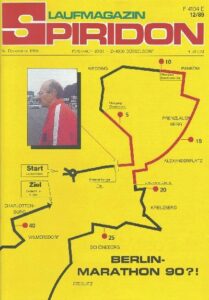
In SPIRIDON Magazine, Manfred Steffny (editor) reflects on the 1990 BERLIN MARATHON course – Photo: Horst Milde
About 25,000 participants from around the world—a non-competitive fun race of about 6 kilometers—from the “Entlastungsstraße” (no longer exists) to the Rotes Rathaus (city hall) (East Berlin) and back, became a global sporting event in the presence of the IAAF President at that time, Nebiolo, and television stations from around the world. There had not been a race through both parts of Berlin for over 30 years.
The motto for the planning of the 1990 BERLIN MARATHON was: “Open the GATE!”
By the beginning of April 1990, the race was already full, with almost 21,000 registrations from over 60 countries. The SCC stopped advertising the race because it did not want to be overrun.
A limit of 25,000 participants was set in order to maintain the usual quality (in the previous year, 1988, 16,410 runners participated in the 16th BERLIN MARATHON).
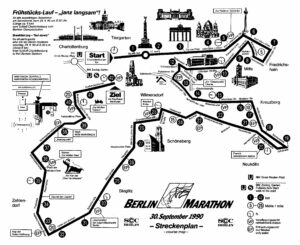
The course of the BERLIN-MARATHON – Photo: Horst Milde
The BERLIN MARATHON reduced the entry fees for participants from East Berlin and the GDR for their runners in 1990. Normal entry fees for the marathon were: 50.00 DM – now reduced to 25.00 DM for participants from the GDR. Companies like Berliner Kindl (beer) sponsored the fees for 100 GDR participants.
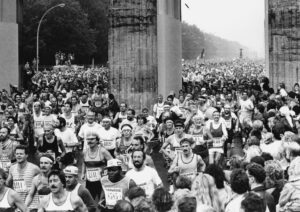
The runners at the Brandenburg Gate. – Photo: Sportmuseum Berlin
In the United States, a fundraising campaign was launched for GDR runners. The Diamond Hill-Jarvis High School from Fort Worth, Texas and the Houlton High School from Houlton, Maine each donated $30,00 for a GDR participant! Other runners took on sponsorships.
The new start in front of the Berlin TU University main building on the Straße des 17. Juni was announced on February 19, 1990, and the route then ran through ten Berlin districts in East and West Berlin—first on Straße des 17. Juni—through the Brandenburg Gate onto the boulevard Unter den Linden.
On March 28, 1990, the organizer received a shock when the Mayor of East Berlin, Dr. Christian Hartenhauer, announced that “due to construction work at the Brandenburg Gate, which is to be completed by the end of October 1990, it will not be possible to include the Brandenburg Gate border crossing area”!
This decision was protested from all sides. Then Dr. Hartenhauer announced on May 3, 1990: “The scaffolding at the Brandenburg Gate will be taken down in time for the Berlin Marathon. This will ensure a passage wide enough for the race.”
And so the first overall BERLIN MARATHON in over 45 years was perfect!
On May 7, 1990, the 17th BERLIN MARATHON was already fully booked with 25,000 partial participants, and 4,000 additional registrations were sent back afterwards; people were asked not to send cash or blank checks.
On August 2, 1990, the organiser SCC was able to report that 1,748 runners from the GDR were among the 25,000 registered participants. This made the BERLIN MARATHON the most popular marathon in the GDR. Neither the Dresden, Leipzig nor East Berlin Peace Marathons ever had more marathon participants!
In terms of organisation, there was something new:
The “blue line” was marked on the course for the first time in Berlin and in Germany – the ideal line. In the night of September 27/28, 1990, a company from London that had been specially flown in applied the “blue line”. In 1989, the winner Alfredo Shahanga wasted a time under 2:10.00 because he ran the many curves instead of taking the shortest route.
On September 15, 1990, the SCC, as the organizer, was informed that 120,000.00 DM had to be paid for the indignant destruction of the Brandenburg Gate, after which the amount was reduced to only 99,000.00 DM. Of course, I objected to Dr. Schäuble, the Minister of the Interior, because three days later, on October 3, 1990, the “reunification” took place, and the BRANDENBURGER TOR should have been just as “outraged” here:
Incidentally, the requested amount was never paid.
On September 14, 1990, the Police (Volkspolizei) of East Berlin informed me that they would not be able to clear the streets of stationary traffic on September 30, 1990, as was always the case in Berlin (West).
On Saturday, September 29, 1990 (the evening before the race), I met with the East Berlin police (Volkspolizei) at 10:30 p.m. at the Brandenburg Gate and explained that with 25,000 participants, clearing the streets would be unavoidable. They desperately tried to call the Police headquarters, but couldn’t get through, and then ran to a phone booth to pass on the information. To save face for the officials, it must be added that the streets were cleared anyway—without any further notification for the residents.
Christoph Kopp, the athletic manager for the BERLIN MARATHON, had the right touch with the engagement of the Australian Steve Moneghetti and the East German Uta Pippig. Moneghetti ran a world-best time of 1:00:34 in the half marathon in Newcastle the previous week and wanted to show in Berlin that he also has a talent for the marathon.
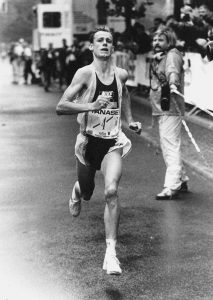
Steve Moneghetti (AUS) – winner of the 1990 BERLIN MARATHON – Photo: Berlin Sports Museum
50 bands and brass bands “played the runners along the course, and traditionally included the bands of the USA, the French and the British Allied forces. New in 1990 was the military band of the Western Group of the Soviet armed forces, the band of the East German Police!
The 17th BERLIN MARATHON thus already anticipated the “reunification celebration” of October 3, 1990 on the streets of Berlin.
The accompanying cultural and informational programme for the 1990 BERLIN MARATHON was held under the motto “Europe is becoming one”. A music, dance, and informational programme took place on three stages at Wittenbergplatz, Herrmannplatz, and Alexanderplatz.
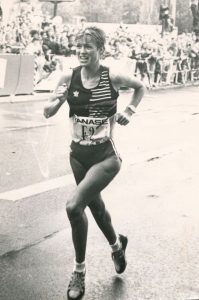
Uta Pippig at her challenging victory in Berlin – Photo: Berlin Sports Museum
YANASE was the main sponsor of the 1990 BERLIN MARATHON. Completely unknown in Europe, the company was famous in Japan as an importer of Mercedes (34,000 imports in 1989) and VW cars (20,000). He provided a Mercedes as a prize for the winner. For Moneghetti, the Mercedes still had to be converted because of the left-hand driving in Australia.
As a result, television also broadcast live to Japan. Since the Quadriga was missing from the Brandenburg Gate due to repairs, the Japanese wanted to replace it with a cardboard version for a better picture – but I refused!
Two mayors gave the starting signal: Walter Momper, the governing mayor of Berlin (West), and Tino Schwierzina, Berlin (East).
Berlin’s hotels were fully booked in both East and West due to the foreign running tourists.
The Berliners were asked to leave their cars at home on the day of the race, especially the drivers of the “Trabant” cars were asked not to pollute the runners‘ air with their exhaust fumes!
Even the post office participated: there was a special postmark for the BERLIN MARATH
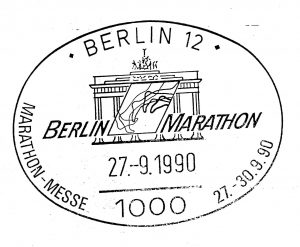
The special postmark for the 1990 BERLIN MARATHON – Photo: Horst Milde
DM 250.00 for a race number: The race number for the runners who had travelled to Berlin was offered for 250.00 – and sold!
The Sender Freies Berlin Radio (SFB) – “The Marathon Wave” broadcasted live from the BERLIN MARATHON from 6:00 a.m. until 2:00 p.m. with weather reports, last-minute advice, reports from the race, lots of music, and ongoing information. There was also the SFB 2 marathon anthem.
ARD-Sport-Extra/SFB broadcasted live from 8:45 a.m. to 12:00 noon from the BERLIN MARATHON nationwide and worldwide.
On September 27, 1990, the “green light” was given for the runners to pass through the Brandenburg Gate. The disarmament work was finished. According to the site manager, the gate would be as “swept and clean as a broom!”
The area around the site is completely level, and the “Verkehrsbau, Aufbauleitung Nord des Magistrats” (Traffic Construction, North Construction Management of the City Council from Berlin – East) has done a “runner-friendly job”; everything is paved, and the area of the demolished wall has been excellently repaired for wheelchair users and runners.
The dream of the runners and organizers from East and West has thus been fulfilled: the route MUST go ONLY through the BRANDENBURG GATE!
The winners of the “unification marathon” are already known and have already received their medals: Uta Pippig and Steve Moneghetti (AUS) – still a national hero in Australia today.
Steve Moneghetti with his world-leading time of 2:08:16 and Uta Pippig with 2:28:37 made the BERLIN MARATHON famous with their winning times and showed that Berlin now belongs to the elite of marathon races. Jörg Peter in third place with 2:09:23 and Stephan Freigang in fourth with 2:09:45 were also able to impress with their performances in Berlin.
It should also be mentioned that the first 3.2 km from the start to the Brandenburg Gate have probably never been run as fast in a marathon as in Berlin, because everyone wanted to be the first to cross the Brandenburg Gate!
In the YouTube video about “eyewitness” Horst Milde, there are scenes from the new start at the Charlottenburg Gate in 1990 (TU Berlin) and the runners passing through the Brandenburg Gate (see link at the end of the article)!
Further details about the organization of the BERLIN MARATHON on September 30, 1990 will have to be left out – there is not enough space – but for all involved, it was certainly exciting and a once-in-a-lifetime adventure in the reunited city of Berlin.
We would like to thank all of those who were present in both the east and the west and helped to make the dream of the runners come true, to run through the gate, which had lasted for years.
Horst Milde
PS: This article is a reprint of an article about the history of the BERLIN MARATHON
The history of the BERLIN MARATHON from 1974. It all began with the 1964 Cross Country Race: The youtube video: „Contemporary Witness ‘Horst MILDE – Berlin’ – Produced by Prof. Dr. Helmut Winter:
Handover of the Berlin Marathon book “Always Marathon!” to Berlin’s Governing Mayor Kai Wegner
