 EN
EN
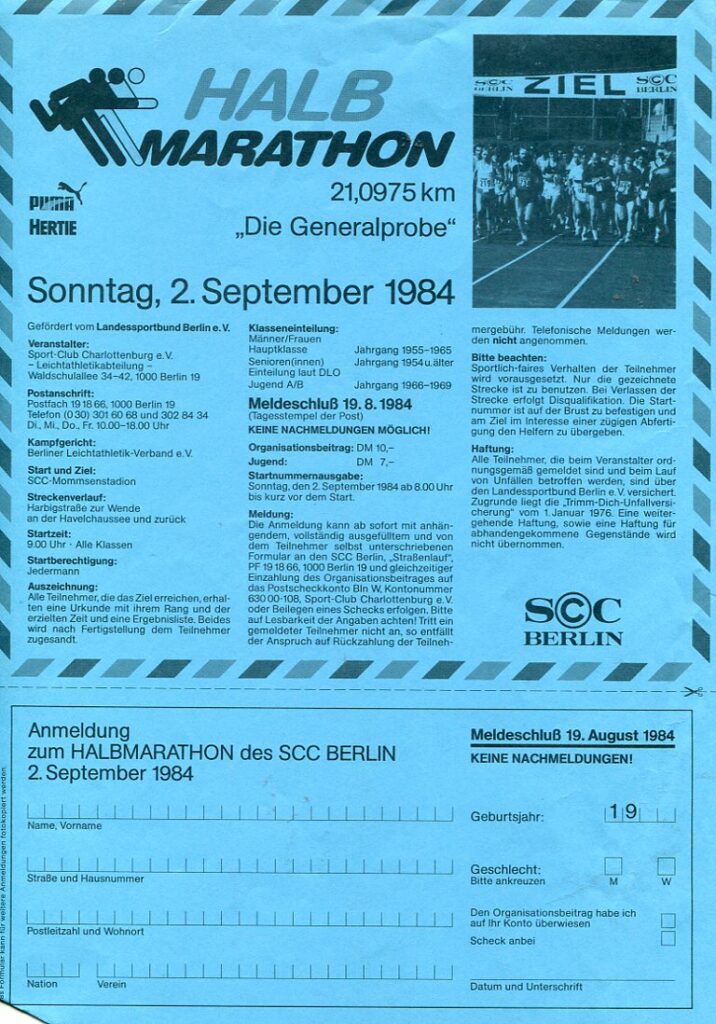
Der Flyer für den 1. Berliner Halbmarathon am Sonntag, dem 2. September 1984 - Foto: Horst Milde
40 years of the Berlin Half Marathon 2024 with two European records by Carsten Eich (GER) and Fabian Roncero (ESP) – founder Horst Milde looks back …
Ingo Sensburg (GER), as a local hero, four-time winner
There are several Berlin race anniversaries this year. These races still play a prominent role in Berlin’s athletics and running history today. These are the „round“ anniversaries this year:
60 years of the Berlin Cross-Country Race (since 1964)
50 years of the BERLIN MARATHON (since 1974)
40 years of the 10 km race in the Tiergarten (since 1984)
40 years of the AVON Women’s Run (since 1984)
40 years of the Berlin Half Marathon (since 1984)
Committed students from the Freie Universität Berlin (FU Berlin) launched the Berlin cross-country race on 8 November 1964 at Teufelsberg and are considered the pioneers for the further development of running in Berlin. The BERLIN MARATHON was founded on 13 October 1974 and celebrates its 50th anniversary on 29 September 2024.
Another Berlin race celebrating its 50th anniversary is the Berlin Half Marathon (since 1984)
It took place for the first time on 2 September 1984 and has a colourful history with rapid developments. Like all other major Berlin races, the half marathon was once founded by Horst Milde. Today, the Berlin Half Marathon is by far the largest in Germany and is considered one of the most popular in the world. It was intended as „the final rehearsal“ four weeks before the BERLIN MARATHON, which will take place this year on 7 April 2024. In the meantime, the „little brother“ of the BERLIN-MARATHON is slowly catching up with the BERLIN-MARATHON with 36,187 participants from 131 nations (2023).
The 5 jubilarians and „figureheads“ of running in Berlin are only part of the „medal“ that has been needed to further develop running in Berlin over the past 60 years. They form the top of the „iceberg“ in the Berlin Athletics Association (BLV), which consists of 75 athletics clubs and organises a total of 220 running events every year. They all contribute to upholding Berlin’s long tradition as a running stronghold (since the 1890s!).
Other stages in Berlin’s development as a running centre are the:
„Berliner Volksmarsch“ over 15 km (1966),
the „Berlin People’s Run“ over 10 km in the Grunewald forest (1967),
the „Berliner Volkswandern“ over 25 km with the BZ (1971),
the „Berlin 25 km race“ (1976),
the „Berlin New Year’s Eve Run“ (from 1977),
the „Berlin New Year’s Run“ (from 1990),
the „City Night on Kurfürstendamm“ (15 August 1992),
the „Berlin 5 x 5 km Team Relay“ (24 June 2000), to name just the most important „gems“ in the SCC’s range of running events.
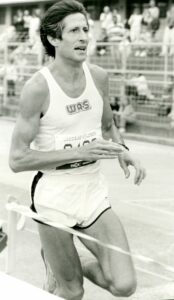
Ingo Sensburg: Four-time winner of the Berlin Half Marathon in 1985/86/87 and 1988, here during his victory in 1985 in the Mommsen Stadium in 1:07:39 – Photo: private
The Berlin Half Marathon was originally conceived as „the final rehearsal“ for the marathon, always four weeks before the „real“ BERLIN MARATHON. Until 1989, the development of the race was relatively „normal“, initially with the start and finish in the Mommsen Stadium at its home venue, later the start was moved to the Messedamm (at the now demolished) Deutschlandhalle. After the fall of the Berlin Wall in 1990, the start and finish locations and courses changed throughout the city.
Even the Berlin Half Marathon – especially after its relocation to the city centre – always had to struggle with the unwilling approval of the regulatory authorities, who still upheld the primacy of cars on the streets. The number of participants grew only very slowly. In this sense, there are parallels to the BERLIN MARATHON, whose original home was also the Mommsen Stadium, the home of the SCC Berlin, with start and finish – exactly 400 metres further on at Waldschulallee 80, where the starting gun for the first BERLIN MARATHON was fired on 13 October 1974.
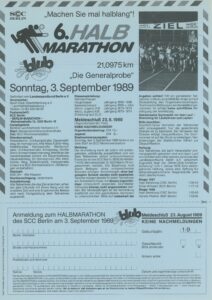
6th Berlin Half Marathon „The final rehearsal“ on 3 September 1989 – Start on the Messedamm – Photo: Horst Milde
Similar to the BERLIN MARATHON, the Berlin Half Marathon has had to reinvent itself several times in its historical development: with the start and finish locations within Berlin changing several times and the times within the calendar year (sometimes in spring, sometimes in autumn).
The number of participants was initially just under 1,000, but then rose steadily but slowly from year to year to over 2,000. The first winner in 1984 was Bernie Dowson, a British soldier stationed in Berlin, in 1:06:51; the women’s race was won by Angelika Brandt from Berlin in 1:22:45, who had also won the BERLIN MARATHON in 1977.
Similar to the BERLIN MARATHON, the Berlin Half Marathon was also a local affair until 1989:
Ingo Sensburg from Neuköllner Sportfreunde (NSF) won the races from 1985 to 1988, and his winning time of 1:06:33 in 1986 was also the course record until 1989. The best-known women’s winner in the early years was Kerstin Preßler (also NSF Berlin), who won in 1985. Her winning time of 1:15:44 in 1985 was the course record until 1990. Kerstin Preßler also won the BERLIN-MARATHON in 1987.
In 1990, the „District Athletics Committee Berlin of the DTSB of the GDR“, headed by Stefan Senkel, rebranded its previous „Peace Run“ as a half marathon and started it on 1 September 1990 in Karl-Marx-Allee with parts of the course also running through the former Berlin (West). This in turn meant that the SCC no longer held its autumn event in September. However, the „Friedenslauf“ organisers did not feel economically able to continue organising this race, so the SCC agreed with Stefan Senkel – as with the Berlin New Year’s Run – to continue using the „Friedenslauf“ emblem at its half marathon for some time and then on 1 September 1991 the half marathon „continued“ under the direction of the SCC with the start in Karl-Marx-Allee (Kino International).
From 1992, the date of the event was moved from autumn to spring, as it seemed to make more sense to organise this ever-growing running event in spring and continue to organise the BERLIN MARATHON in autumn. Two little anecdotes should be noted in between: It was very stormy at the race in 1993. The tents for the changing rooms and the distribution of race numbers were set up in a large car park in Alexanderstraße. Suddenly, a strong gust of wind blew away the tents for the changing rooms and organisation. A call to the fire brigade helped: Albrecht Broemme, the state fire chief at that time, had the fire station a short distance away opened and the runners were able to use the station to change and store their clothing.
In 1994 – as a second anecdote – 30 crates of bananas were ordered for the finish, but 130 boxes were delivered by mistake. This meant extra work for the organisers and more banana food for the finishers at the finish line. The following day, the leftover bananas were delivered to the neighbouring retirement homes and later even to Berlin Zoo. Everyone was delighted with the fresh fruit …
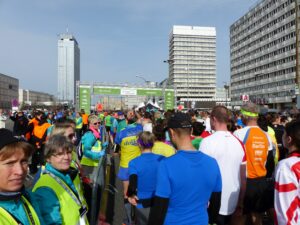
Berlin Half Marathon with start in Karl-Marx-Allee (near Alexanderplatz) – Photo: Horst Milde
Over the next few years, we were able to use the congress hall on the corner of Alexanderstraße for the organisation. However, the start and finish locations had to change several times due to construction work. In 1992, 2,378 participants registered for the 9th Berlin Half Marathon. By comparison, the BERLIN MARATHON already had 13,350 finishers in 1992. To the disappointment of the organisers, the number of participants in the Berlin Half Marathon continued to grow very slowly.
The race community only focussed on the BERLIN MARATHON. It was not until 2003 that the Berlin Half Marathon reached 10,998 participants, although by then the BERLIN MARATHON already had 30,709 finishers.
The running route was attractive with the boulevard „Unter den Linden“, passing through the Brandenburg Gate, the Victory Column to the turnaround at Charlottenburg Palace, back along Kurfürstendamm, past the Kaiser Wilhelm Memorial Church to „Checkpoint Charlie“ and the finish line, initially in Alexanderstraße. Later, the race finally moved to Karl-Marx-Allee with the start and finish.
The winning times at the Berlin Half Marathon, on the other hand, became faster and faster after reunification: Stephan Freigang (LC Cottbus) won in 1990 with 2:01:14. On 4 April 1993, the records got even better: Carsten Eich (Leipzig) won in a new European record time of 1:00:34. If he had run a day earlier, there would even have been a world record, as Moses Tanui ran 59:47 the day before. Kathrin Weßel (SCC Berlin) ran a time under 1:11:00 with 1:10:47 in 1994, Marleen Renders (BEL) improved the course record to 1:10:04 in 1998, until Joyce Chepchumba (KEN) greatly improved it to 1:08:22 in 2000
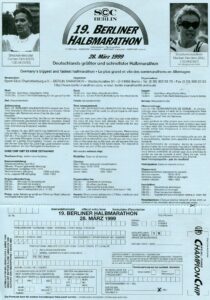
The 19th Berlin Half Marathon in 1999 with European record holder Carsten Eich (GER) (top left in the corner) – Photo: Horst Milde
After Carsten Eich, Fabian Roncero (ESP) set the second European record of 59:52:00 at the Berlin Half Marathon in 2001, which also marked the breakthrough for the Berlin Half Marathon on the international scene. In addition to the BERLIN MARATHON, the organiser SCC Berlin thus had another international ace up its sleeve for running events. As recently as 2006, Paul Kosgei improved the course record to 59:07. In 2009, Sabrina Mockenhaupt (GER) won the women’s race in an impressive 1:08:45.
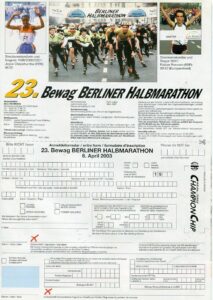
The 23rd Berlin Half Marathon 2003 with the European record holder Fabian Roncero (ESP) (top right in the corner) – Photo: Horst Milde
In 2004, the start and finish were moved to the Schloßbrücke for the first time, with the Lustgarten as a decorative finish area. The race expo took place at the fairgrounds. In 1997, the Berlin Half Marathon served as a „test object“ for the introduction of inline skating at international running events. The project was a resounding success and it was also introduced with great success at the BERLIN MARATHON in the same year: Berlin was once again a trendsetter with this new discipline.
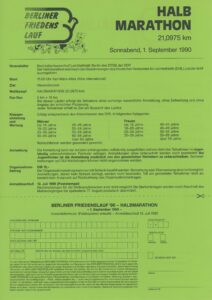
The „District Athletics Committee Berlin of the DTSB of the GDR“ with Stefan Senkel changed its „Peace Run“ to a half marathon in 1990 and raced through parts of the former Berlin (West) – Photo: Horst Milde
From 2011 to 2018, the start and finish were located on Karl-Marx-Allee, but from 2019, due to necessary construction work, the start and finish area was changed to Straße des 17. Juni, similar to the BERLIN MARATHON, with the finish shortly after passing through the Brandenburg Gate.
This is also the goal in the anniversary year 2024 and will certainly remain so in the years to come!
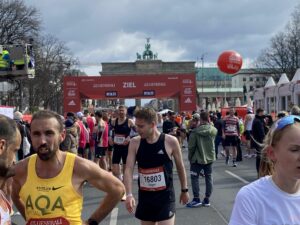
The crowd after the finish on Strasse des 17. Juni after passing through the Brandenburg Gate – Photo: Horst Milde
The Berlin Half Marathon, which covers exactly 21.0975 km, is a race for everyone … for runners, inline skaters, wheelchair users, handbikers and, on the day before, for children over shorter distances. Eric Kiptanui (KEN) improved the course record to 58:42 in 2018, while Sheila Chepkirui (KEN) ran the most recent women’s course record of 1:05:02 in 2022.
Like the World Marathon Majors in the marathon, the Berlin Half Marathon is now also a member of the European SuperHalfs Series 2024.
Horst Milde
Founder BERLIN-MARATHON
Founder of the Berlin Half Marathon (including many races in Berlin)
Witness in running and athletics: Horst Milde – Berlin – The video by Prof Dr Helmut Winter:
Sie sehen gerade einen Platzhalterinhalt von Standard. Um auf den eigentlichen Inhalt zuzugreifen, klicken Sie auf den Button unten. Bitte beachten Sie, dass dabei Daten an Drittanbieter weitergegeben werden.
Berlin, the sports capital and the races anniversaries in 2024:
60 years of the Berlin Cross-County Race – 50 years of the BERLIN MARATHON –
40 years of the Berlin Half Marathon – 40 years of the 10 km race in Tiergarten –
40 years of the AVON Women’s Race. Horst Milde reports:
https://news.germanroadraces.de/?post_eng=berlin-the-sports-capital-and-the-races-anniversaries-in-2024-60-years-of-the-berlin-cross-county-race-50-years-of-the-berlin-marathon-40-years-of-the-berlin-half-marathon-40-years-of-the-10-k
