 EN
EN
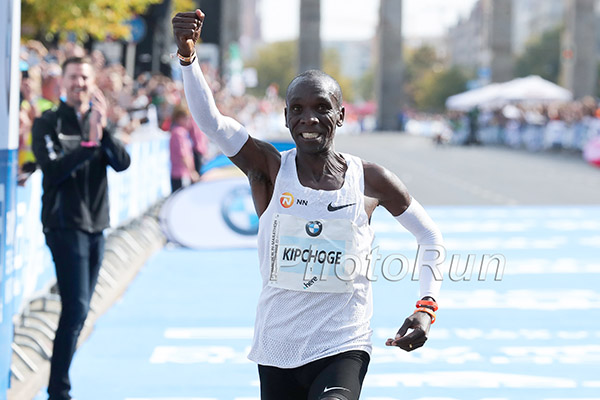
Equilibrium is restored. Eliud Kipchoge, a man who can already lay claim to being the greatest male marathon runner in history underlined that status by finally adding the kudos of world record holder to his curriculum vitae.
In the latest (and greatest?) of a string of world records on the race track that is the Berlin Marathon course, Kipchoge took one minute and 18 seconds off Kenyan colleague Dennis Kimetto’s time on the same course four years ago, recording two hours, one minute and 39 seconds (2.01.39).

Photo: Victah Sailer@PhotoRun
Further endorsement of the stature of this run is that this is the largest margin of improvement in an event which should be subject to diminishing returns, in over 50 years; since Derek Clayton, the Lancashire born Aussie took over two minutes off Morio Shigematsu’s time, with 2.09.36 in the world’s leading marathon at that time, Fukuoka, in 1967.
It was no minor achievement to run 2.02.57, as Kimetto did in Berlin 2014; but, apart from a third place in London 2015, Kimetto has done little since to substantiate his celebrity, whereas Kipchoge has provided ample and consistent proof of his. In a career, which began with an unheralded victory in the 5000 metres at the IAAF World Championships in Paris 2003, this modest and unassuming man has quietly gone about writing a resume which includes silver medals at both Olympic Games and further World Champs, plus an Olympic bronze; finally culminating in Olympic gold in the marathon in Rio two years ago. In addition, he has the best overall 5,000/10,000 metres and marathon times combined. And now the ultimate triumph, with his tenth victory in 11 marathons, a world record which will not be easily broken.
When the allegedly teenaged Kipchoge emerged from the ether to defeat two all-time track ‘greats’, Hicham El Guerrouj and Kenenisa Bekele in Paris 15 years ago, there were two things which stood out; his hitherto anonymity (he had won the world junior cross earlier that years, but even so…); and the evocation of Kenyan athletic history by being the first to share a name with his illustrious predecessor, Kipchoge Keino. And now this Kipchoge has elevated himself into the same stratosphere as the founding father of the sport in Kenya.
As is often the case in East Africa, where birth records in country communities are scant, the likelihood, as with Haile Gebrselassie (and I have this from reliable informants, in both cases), is that Kipchoge is three or four years older than his stated age, of 33. Which makes this achievement, as with Haile’s, even more extraordinary and laudable.
That Kipchoge was amply capable of breaking the official world record was demonstrated when he was paced by a succession of elite runners, and sheltered by a lead car on the ultra-smooth surface of the Monza racing circuit last year, recording a time of 2.00.25*. It could not, of course be accepted as an authentic world record. But, despite being led in Berlin by the inevitable pacemakers, they could only last until 15 and 25k, and Kipchoge then accelerated, running the final 17 kilometres alone, and winning by over three minutes.
In pleasingly clement conditions, he set the 11th world record in the 45 years of the Berlin Marathon. However, ten of those records have come in the last 20 years; but this one, I suspect will be unassailable, except maybe by an ageing Kipchoge, for many years to come.
Pat Bucher
Posted on Sunday, September 16th, 2018 at 3:35 pm and is filed under Butcher’s Blog, Marathon | 0
* https://www.globerunner.org/05/o-superman/
* https://www.globerunner.org/08/whos-the-daddy/
